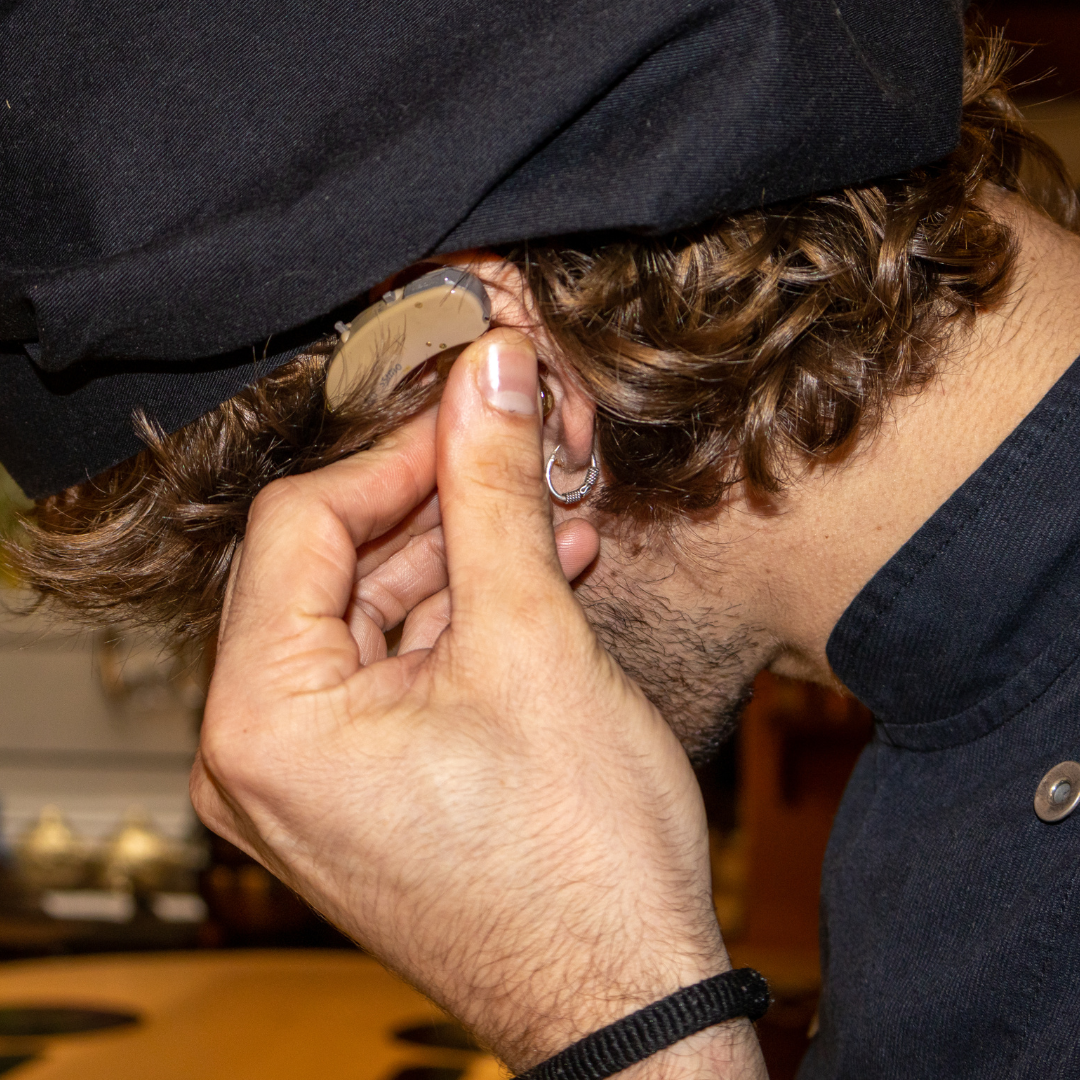
Restaurant conversations can be difficult to follow when environmental noise competes with your focus and hearing. We perform comprehensive diagnostic assessments to evaluate hearing in quiet rooms and challenging acoustic spaces to identify functional deficits. As soon as we identify the physiological cause of your difficult hearing, we deliver personalized rehabilitation options.
Why Do I Hear Well in Quiet but Struggle in Restaurants?
Low-noise environments yield an advantageous signal-to-noise ratio where primary speech remains significantly louder than background sound. Restaurants create the opposite situation. Background voices, loud music, service clatter, and wall reflections collide with spoken words, demanding heightened cognitive processing to isolate individual speech.
Such difficulty frequently signals sensorineural high-frequency hearing loss, auditory processing dysfunction, or noise-induced cochlear damage. Visual limitations from low lighting, cognitive fatigue, and sitting farther away from conversational partners amplify speech degradation. Numerous individuals show standard hearing thresholds on paper but reveal marked comprehension drops on clinical speech-in-noise testing. Disproportionate difficulty in restaurants justifies professional clinical assessment even if your everyday home hearing appears intact.
Diagnostic Protocols for High-Frequency Hearing Loss
We initiate evaluation by exploring challenging acoustic environments, acoustic trauma history, subjective tinnitus, prescription drug profiles, and unilateral ear changes.
Diagnostic pure-tone audiometry establishes the softest auditory thresholds you can perceive across standardized frequencies via air and bone conduction pathways. High-frequency loss often creates an audiogram pattern in which thresholds become poorer as pitches rise. Further clinical diagnostics feature tympanometry to evaluate eardrum and middle-ear mechanics as well as word-recognition testing for speech comprehension.
A quiet sound booth cannot replicate complex dining room acoustics, which makes clinical speech-in-noise testing especially informative. The test assesses word and sentence discrimination as background acoustic competition intensifies. Combined, these clinical findings determine whether your symptoms stem from acoustic audibility, word clarity, central noise filtering, or multifactorial causes.
How Auditory Processing Difficulties Impact Adult Hearing
An auditory processing disorder compromises how the central auditory pathways and brain decode incoming acoustic information. The ears may detect tones at expected levels, but the brain may have difficulty organizing competing signals, distinguishing similar speech sounds, or following rapid conversation. We systematically verify peripheral hearing health before establishing whether an advanced auditory-processing evaluation or medical referral serves your needs.
Effective Techniques to Hear Better in Noisy Surroundings
Simple situational adjustments enhance the speech signal entering your ears and offer clearer facial cues. Prior to dining, choose venues known for lower noise levels or schedule meals during quieter dining hours. Settings constructed with comfortable booths, acoustic ceiling panels, drapery, and carpeted walkways facilitate easier communication than open venues with concrete and glass.
While seated at the restaurant:
- Ask host staff for a quiet table distanced from kitchen traffic, bar noise, audio speakers, and loud group tables.
- Position yourself with your back toward a solid partition to dampen intrusive background noise from behind.
- Face your speaking partners directly in well-illuminated seating to maximize visual speech cues.
- Sit as close to the speaker as comfort permits to preserve speech volume and clarity.
- Place your better-hearing ear toward the person you most want to hear.
- Encourage speakers to rephrase key information rather than simply repeating unparsed words louder.
- Clarify critical details explicitly instead of nodding along or pretending to catch the message.
- Allow yourself a short listening respite when auditory concentration starts to feel drained.
- Ask dinner guests to speak with clear enunciation at a steady, natural conversational rate.
- Speaking with excessive volume creates acoustic distortion that fails to make words clearer.
Advanced Technology for Hearing in Background Noise
Determining the proper hearing technology hinges on the underlying disorder, everyday listening environments, and whether peripheral hearing loss is diagnosed. Customized hearing aids employ directional microphone beamforming, noise cancellation algorithms, and targeted dining programs to prioritize speakers in front while lowering ambient noise. Patients must uphold realistic expectations because modern amplification cannot strip out every ambient human voice completely.
Incorporating a dedicated remote microphone provides an even more pronounced improvement in signal-to-noise ratio. Clipped near the speaker’s mouth or set nearby, the transmitter sends voice signals wirelessly to matched hearing aids or a receiver. Direct audio routing minimizes the acoustic penalty of conversational distance and surrounding environmental din.
Other clinically valuable tools include:
- Table microphones for small-group conversations
- Telecoil components connecting directly to public hearing-loop systems
- Mobile device live-captioning programs and speech-to-text transcription software
- Over-the-counter hearables equipped with directional speech-enhancement algorithms
- Decibel-level applications and restaurant rating guides for finding quiet tables
We can compare options, confirm compatibility, and teach you how to use the selected device.
Professional Audiological Solutions for Loud Listening Environments
A thorough audiological evaluation expands the diagnostic scope well past simple quiet listening performance. We assess the specific acoustic settings, speaker dynamics, and volume levels that disrupt your hearing to administer targeted evaluations. Testing routinely combines pure-tone audiometry, middle-ear impedance tests, speech discrimination, and speech-in-noise measures. Auditory-processing testing may be considered when the history and initial results support it.
Any sudden, asymmetric, or rapidly deteriorating hearing loss demands immediate medical evaluation by an ear, nose, and throat physician. Tailored audiological treatment identifies the exact origin of listening breakdown rather than assuming environmental dining noise is the sole culprit.
Book Your Comprehensive Hearing Evaluation Now
If noisy restaurant gatherings leave you struggling to follow dialogue, pulling away, or feeling completely drained, schedule an audiological evaluation with our team. We can explore ways to help with hearing in noisy environments with hearing-aid adjustments, assistive tools, or rehabilitation options that may fit your needs.
Contact our practice today to book your consultation and take a decisive step toward reconnecting in social settings.
The content of this blog is the intellectual property of MedPB.com and is reprinted here with permission.
The site information is for educational and informational purposes only and does not constitute medical advice. To receive a personalized free hearing test and hearing loss consultation, call today to set up an appointment.