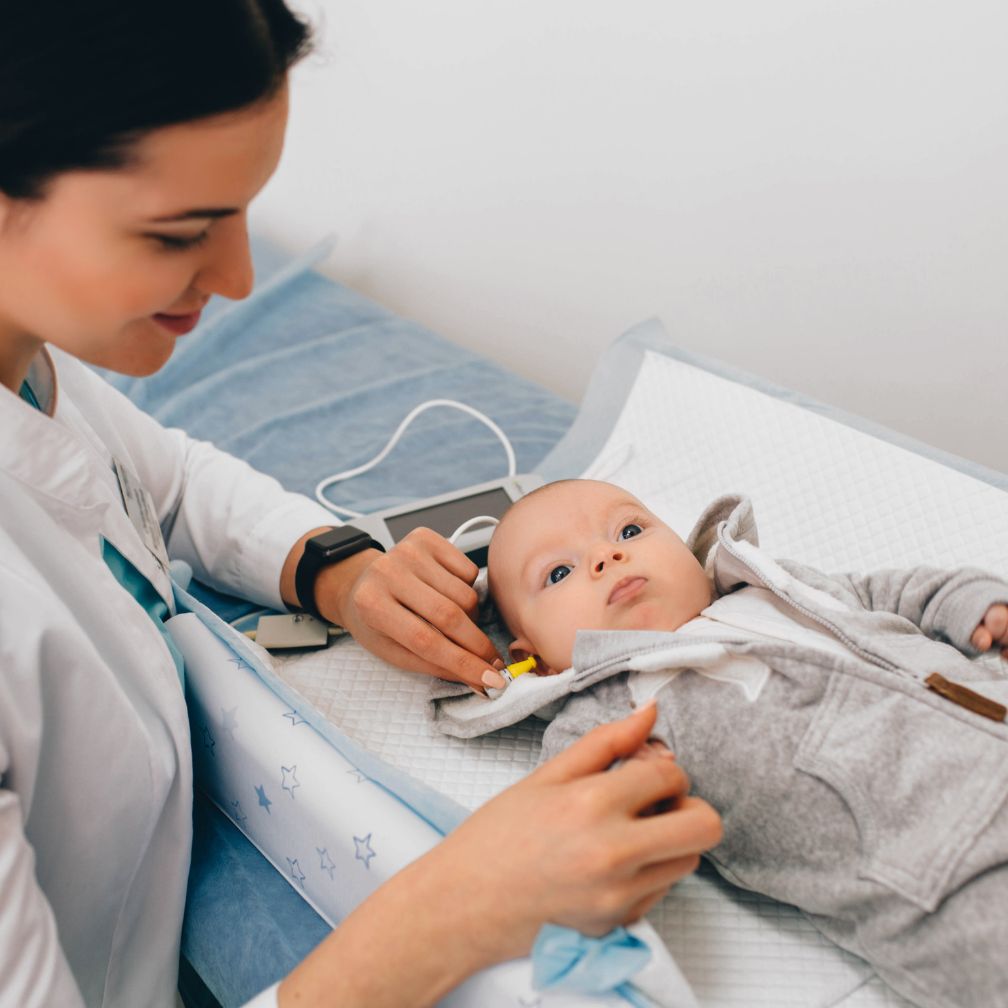
For guardians of newborns, discovering that an infant faces auditory obstacles can prove extremely emotionally overwhelming. The positive takeaway remains that through the use of early evaluations and supportive care, infants experiencing hearing loss are able to excel. Truly, these infants routinely acquire language proficiency, interpersonal skills, and deep relationships with those around them, building toward a prosperous life!
Utilizing individual hearing aids alongside surgical cochlear implants offers two exceptionally successful approaches for supporting infants with hearing loss. Within this guide, we review their working mechanisms to guide you in choosing the best pathway for your infant.
Analyzing Infant Auditory Deficits
Hearing impairment across infants can result from various distinct health factors, such as:
- Potential genetic predispositions (even in the absence of recorded familial lineage)
- Congenital infections such as cytomegalovirus (CMV) or German measles
- Severe delivery difficulties, such as acute oxygen deprivation or premature delivery
- Certain medications used in neonatal intensive care
Which part of the process proves most critical? Swift medical diagnosis. Because of this, newborns throughout the United States undergo testing for hearing loss before leaving the hospital. Board-certified pediatric audiologists strictly uphold the universal “1-3-6” care benchmark:
- Early screening completed before 1 month of age
- Formal diagnostic verdict achieved inside 90 days of life
- Comprehensive management (employing modern technology or rehabilitation) established prior to 6 months
Reaching these clinical benchmarks grants babies an ideal foundation for strong speech, linguistic, and brain development. Should you seek direction concerning these newborn checks, your family pediatrician will gladly offer support!
Understanding Amplification Devices for Infants
For babies with mild to severe hearing loss, hearing aids are often the initial treatment approach. These compact, body-worn units boost incoming sound waves, helping babies hear speech and environmental sounds more clearly.
Hearing aids are:
- Exceptionally safe for pediatric application in infants only a few weeks after birth
- Built using flexible, comfortable ear impressions that adapt as the infant grows
- Outfitted with child-resistant battery compartments and custom pediatric safety options
- Professionally configured by a pediatric audiology specialist to accommodate your infant’s exact hearing needs
As your baby grows, their hearing aids require regular clinical updates to secure accurate fit and optimal therapeutic benefit.
Cochlear Implants for Infants
If a baby exhibits severe to profound sensorineural hearing impairment while demonstrating limited success with standard amplification, a cochlear implant stands as a primary recommendation. Diverging significantly from traditional hearing devices, surgical cochlear implants:
- Demand a dedicated surgical procedure for placement within the temporal bone area
- Safely bypass damaged hair cells across the inner ear system
- Transform acoustic energy into electrical impulses that directly excite the auditory nerve
Modern cochlear implants serve as:
- Officially FDA-approved for use in infants reaching 9-12 months of age
- Highest in overall efficacy when combined with early intervention services and strong family involvement
- Recommended solely following extensive diagnostic reviews by a certified audiologist and otolaryngologist
That pre-surgical path incorporates high-resolution imaging, specialized auditory testing, and in-depth discussions surrounding achievable long-term goals.
Hearing Aids or Cochlear Implants: Distinguishing Features
- Mild to severe hearing loss relies on Hearing Aids; Severe to profound hearing loss requires Cochlear Implants
- Non-Invasive external fitting: Hearing Aids; Surgical internal implantation: Cochlear Implants
- Sound processing amplification: Hearing Aids; Electrical signal stream conversion: Cochlear Implants
- Treatment starts in newborn infancy: Hearing Aids; Procedure starts at 9-12 months: Cochlear Implants
Hearing Aids vs. Cochlear Implants: Final Thoughts
In the event your infant receives a hearing loss diagnosis, you can rely on excellent technological options and dedicated expert support. Through the guidance of experienced pediatric audiology teams, many children go on to develop language skills that are on par with their peers.
Regardless of whether your baby requires wearable hearing aids or a surgical cochlear implant, early intervention can make a lifelong difference.
Do you need professional advice regarding your baby’s current hearing health? Reach out to our specialists today to receive a complete diagnostic assessment and personalized rehabilitation plan.
The content of this blog is the intellectual property of MedPB.com and is reprinted here with permission.
The site information is for educational and informational purposes only and does not constitute medical advice. To receive a personalized free hearing test and hearing loss consultation, call today to set up an appointment.